
Introduction: The New Era of Digital Visibility
Being visible in the digital world is no longer possible solely through keyword and backlink strategies. With technology giants such as Google and Bing integrating AI-powered search engine models into their core services, content strategies and competitive rules are undergoing a profound transformation. At the center of this shift are systems that understand user intent more deeply, process multimodal (multiple data types) inputs, and generate direct responses to long, complex queries. This new environment highlights not only Search Engine Optimization (SEO) but also the growing importance of a new discipline: Generative Engine Optimization (GEO).
At its core, GEO refers to a set of strategies aimed at maximizing the visibility of your brand, products, or ideas within the summaries and direct answer boxes generated by AI-powered search engines. Unlike SEO, which focuses primarily on ranking, GEO ensures that content is easily summarizable, quotable, and recognized as trustworthy by AI. This guide explores how artificial intelligence is redefining search engines, the key components of GEO, and the technical and strategic steps brands must take to strengthen their digital visibility. More than superficial insights, this guide provides readers with a truly actionable, technically grounded roadmap.
This journey emphasizes the importance of approaching your content from an AI perspective, moving beyond traditional methods.
The following table clearly demonstrates the philosophical and practical differences between SEO and GEO.
Table 1: Comparison of Traditional SEO and GEO Strategies
| Strategy Area | Search Engine Optimization (SEO) | Generative Engine Optimization (GEO) |
|---|---|---|
| Primary Focus | Ranking (Search Engine Results Page – SERP) | Visibility in AI Overviews & Citations |
| Critical Factors | Keyword density, backlinks, metadata, page speed | Semantic context, user intent, credible sources, content structure, E-E-A-T |
| Content Style | Keyword-optimized blog posts | Direct answers to user questions, easily summarizable, data-driven, authoritative |
| Technical Applications | URL, title, and meta tag optimization | Structured data (schema markup), topic maps, multimodal content (video, visuals, infographics) |
| Measurement | CTR, keyword ranking, organic traffic | Brand mentions, direct query visibility, “memorability” |
| Content Goal | Driving users to the site | Answering users’ questions directly, establishing authority, positioning brand as knowledge source |
II. Technical Functioning of AI-Powered Search Engines
Understanding how AI-powered search engines operate forms the foundation for optimizing content for these systems. Unlike traditional search algorithms, these systems function in a far more complex structure and aim to grasp the full semantic depth of language rather than relying solely on keywords.
Large Language Models (LLMs) and the Search Experience
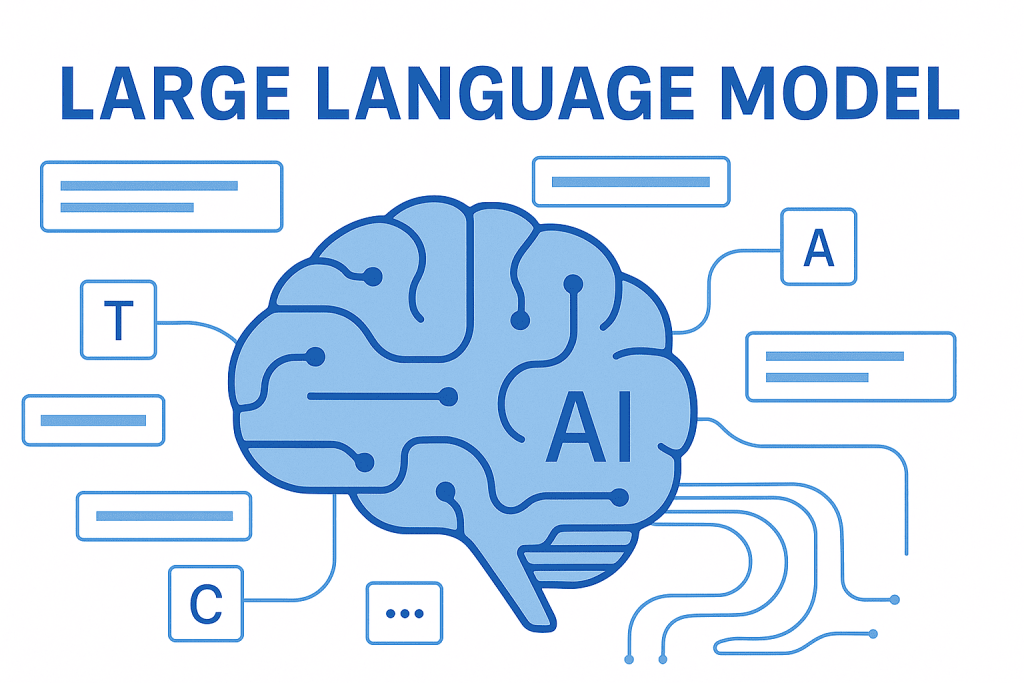
LLMs mark a turning point in the evolution of search engines. While traditional search engines since the 1990s have primarily relied on keyword matching to deliver results, modern systems like Google SGE (Search Generative Experience) have shifted to models that understand user intent and produce direct answers to queries.
An LLM consists of three main components: massive datasets, a neural network based on transformer architecture, and the training process. This transformer architecture enables the model to process relationships among words in a text sequence simultaneously. Thus, instead of just matching words, the model can correctly interpret the context and semantic depth of the query.
Beyond Ranking: Semantic Search and Vector Databases
Semantic search is built on understanding the true intent and context behind a user’s query. Instead of merely matching keywords such as “best laptop,” semantic search addresses more complex questions like: “Which laptop is best suited to my needs based on performance, price, and brand reputation?”
At the heart of this semantic capability lies Vector Embeddings technology. Vectors are numerical representations that encode semantic relationships of text, visuals, or other data types in a multi-dimensional space. For example, terms like “laptop,” “notebook,” and “portable computer” are positioned close together in this vector space since they share the same meaning.
Where traditional SEO focuses on keyword density, vector-based systems evaluate the semantic integrity and depth of content. An article that comprehensively covers a topic—not just a single keyword—will occupy a central position in this vector space, strengthening its topical authority. This means that content creation is no longer just about being visible but also about being recognized as a credible and comprehensive knowledge source.
Mechanism of Knowledge Generation: Retrieval-Augmented Generation (RAG)
The ability of LLMs to produce direct and accurate answers is powered by a mechanism called Retrieval-Augmented Generation (RAG). RAG enables LLMs to combine their internal knowledge (learned from training data) with external and up-to-date sources (web pages, academic articles, statistics) to generate responses.
When a user submits a query, the system first retrieves relevant information from external databases (or the web) and then uses it to produce a coherent and accurate response.
This mechanism supports the core philosophy of GEO. Unlike traditional search engines that focus solely on ranking a single page, RAG synthesizes information from multiple sources when responding to a query. This means it is not enough for your content to rank high—you also need it to be selected by RAG as reliable, comprehensive, and easily summarizable. Thus, content production must be strategically planned not only to attract clicks but also to be directly quoted by AI and integrated into its answers.
The Technology Behind Google SGE and Bing Copilot
Search giants are leading this transformation.
- Google SGE is powered by multiple LLMs (Multitask Unified Model – MUM, PaLM2, LaMDA, and Gemini). This multi-model approach delivers a personalized, multimodal (text, visuals, and audio) search experience with low latency. Its conversational mode allows users to search interactively, retaining the original query context and helping them gain deeper insights.
- Bing Copilot, on the other hand, is built on OpenAI technology. One of its key architectural concepts is Web Grounding. This mechanism analyzes user queries, determines which terms require additional support from web search, and fetches relevant data from Bing’s search service. Microsoft has also introduced privacy safeguards. Queries sent to web search do not include user or tenant identifiers and are not used to train the core models. This makes Bing Copilot especially attractive to enterprise users who prioritize data security and privacy.
III. Core Pillars of Content Strategy: E-E-A-T and YMYL
In the age of artificial intelligence, technical optimization alone is not enough. The quality, credibility, and proof of human authorship of content have become more decisive than ever for search engine algorithms. Within this framework, the concepts of E-E-A-T and YMYL, which form the basis of Google’s quality guidelines, carry great importance.
E-E-A-T (Experience, Expertise, Authoritativeness, Trustworthiness) and Search Algorithms
E-E-A-T is an acronym for the four fundamental elements used to assess the value and reliability of content: Experience, Expertise, Authoritativeness, and Trustworthiness. AI-powered search engines are now evaluating these factors more aggressively. Algorithms do not merely check whether the content provides accurate information, but also who provides it and with what experience.
The biggest dilemma AI introduces into content production arises in the Experience and Expertise components of E-E-A-T. While AI can mimic human responses based on training data, it cannot have real experiences: it cannot use a product, visit a place, or establish an emotional connection. Similarly, AI tools do not hold diplomas, professional experience, or certifications. In fact, there have been reported cases of AI generating fabricated court citations or imaginary events.
This proves why human expertise is indispensable for enhancing the value and reliability of content. For a successful GEO strategy, AI can be used as a tool for speed and efficiency, but the final content must reflect the experience, knowledge, and credibility of a human expert.
YMYL (Your Money or Your Life) Content: Critical Safeguards
Your Money or Your Life (YMYL) refers to content that may influence critical user decisions in areas such as finance, law, health, or safety. In the age of AI, misinformation can spread rapidly, so this category of content is subject to stricter scrutiny by search engines. AI tools are trained to avoid surfacing potentially harmful content.
To manage these risks, content creators must adopt a transparent and credible strategy:
- YMYL content should not be written by anonymous authors but by qualified professionals (e.g., doctors, lawyers, financial experts), or at least reviewed by them.
- Author bios should clearly display identity details, certifications, and professional experience.
- Adding disclaimers strengthens the trustworthiness of such content.
- Explicitly stating that AI was used while also emphasizing that content has undergone human review is critical for gaining trust from both readers and machine algorithms.
IV. Advanced Optimization (GEO) Techniques for Generative Search Engines
GEO preserves the foundation of traditional SEO while adding unique, advanced techniques to adapt to the new search ecosystem. These techniques aim to transform your content from being just a web page into a digestible knowledge source for AI.
Bridging Traditional SEO and GEO
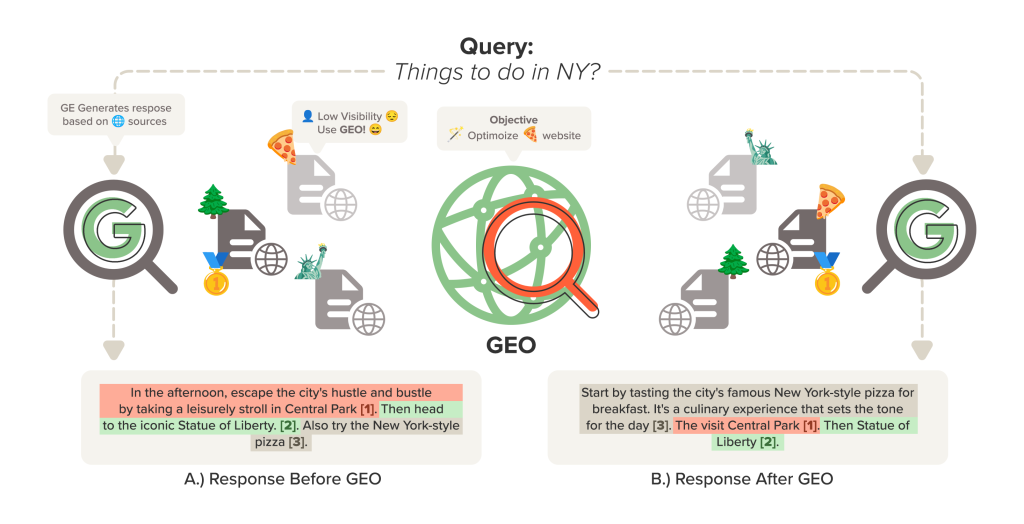
The core pillars of traditional SEO (backlinks, on-site optimization, metadata) remain valid. However, GEO builds upon this base. While traditional SEO focuses on ranking higher on the Search Engine Results Page (SERP), the ultimate goal of GEO is to be featured in AI-generated summaries that directly answer user queries.
This shift opens a new opportunity: a website can increase traffic not only through organic rankings but also by earning citations in AI-powered search responses.
Semantic SEO and Topical Authority
Topical authority refers to a website being recognized as an expert and trusted source on a specific subject. AI-driven search engines are highly effective at evaluating how comprehensively a site covers a given topic.
Instead of a keyword-focused strategy, the Topic Clustering method should be adopted. This involves creating a pillar page that covers the main subject and linking it internally to supporting subtopic pages that provide detailed insights.
- This structure signals to search engines that your site addresses the subject in depth.
- Internal links improve user navigation and help AI systems better understand the semantic relationships within your content.
Example of Topic Clustering
| Main Topic (Pillar Page) | Supporting Subtopic (Cluster Content) | Semantic Relation |
|---|---|---|
| Web Design | Importance & Applications of Mobile-Friendly Design | “Web Design” ↔ “Mobile-Friendly Design” |
| Web Design | User Experience (UX) Principles & Website Integration | “Web Design” ↔ “UX” |
| Web Design | Website Security & HTTPS Protocol | “Web Design” ↔ “Security” |
| Web Design | Best Content Management Systems (CMS) Comparison | “Web Design” ↔ “CMS” |
| Web Design | SEO-Friendly Web Design & Implementation Steps | “Web Design” ↔ “SEO” |
LLM Seeding and Brand Visibility Strategies
This strategy—explicitly requested by many marketers—represents one of the most advanced dimensions of digital visibility in the AI era. LLM Seeding is the process of strategically placing content on platforms from which models gather training data or extract real-time citations.
While traditional SEO aims to ensure that search engines index and rank your content, the goal of LLM Seeding is for the model to internalize your content so your brand or unique ideas are quoted in conversational answers.
This strategy prioritizes brand memorability and citation potential rather than CTR. Research by Ahrefs shows that branded web mentions are the factor most strongly correlated with AI visibility. This highlights the importance of off-site GEO or AI Optimization (AIO).
Detailed Action Plan
- Identify Model Learning Sources
- Unlike search engine crawlers, LLMs learn from different sources. The most effective platforms are high-authority, frequently updated, and publicly accessible.
- Examples:
- Reddit → Participate in niche subreddits by providing in-depth, helpful answers to real user questions.
- Wikipedia → Be cited as a reliable source in industry-relevant articles.
- GitHub → Share knowledge via technical documentation, discussions, or README files.
- Quora & Medium → Publish expert guides, comparisons, and Q&A format content.
- Redefine Content Strategy
- Write not only for ranking but for memorability.
- Models respond best to clear, consistent, and contextually rich language.
- Define concepts, terms, or frameworks in a way that others can easily quote, use a brand-specific tone, and provide real-world decision-making explanations.
- Mention & Citation Strategy
- Increase brand mentions through active strategy.
- Begin with competitor analysis (study how AI interprets competitors and identify positioning gaps).
- Publish comparison guides listing your product/service alongside known competitors.
- Request peer amplification: ask customers, partners, or influencers to mention or reference your brand in their Reddit, Quora, or Medium content. This strengthens distribution diversity and authority.
- Measure Success
- Unlike traditional metrics (traffic, keyword rankings), LLM Seeding success is measured by whether models mention your brand or ideas.
- Test directly by asking models like ChatGPT or Claude questions your target audience might ask, then analyze responses to see if your brand or concepts appear.
Example Platforms & Optimization Tactics
| Platform | LLM Learning Mechanism | Content Optimization Tactics |
|---|---|---|
| High training inclusion, real-time info retrieval | Join niche communities, provide in-depth answers | |
| Wikipedia | Very high training inclusion, real-time info retrieval | Get cited as an authoritative industry source |
| Medium | Good training inclusion, decent real-time info retrieval | Publish structured expert guides |
| Quora | Good training inclusion, strong real-time info retrieval | Use Q&A format, provide quotable answers |
| Low training inclusion, decent real-time info retrieval | Share leadership insights & trend analyses |
Technical GEO Applications
To make content easier for LLMs to process, technical optimizations must also be implemented:
- Structured Data (Schema Markup): Provides direct information about your content to search engines. Using schema types like FAQ, HowTo, Product snippets increases the likelihood of AI surfacing your content in summary boxes.
- Paragraph & List Structuring: AI models prefer clear and summarizable content. Avoid long, complex sentences, present main ideas in short paragraphs, and summarize complex info with tables, bullet points, or numbered lists.

V. Roadmap and Recommendations: Future-Oriented Strategies
Adapting to this new era of digital marketing requires a series of strategic shifts.
Human–AI Collaboration in Content Production
Using AI as a content creation tool provides speed and efficiency. AI can handle tedious yet necessary tasks such as keyword research, topic ideation, outline creation, meta descriptions, and schema markup.
However, human experience, unique perspective, and E-E-A-T signals remain indispensable for ensuring content quality and credibility. The best results come from a hybrid model where human expertise is supported by AI tools.
The Importance of Understanding User Intent
The ultimate goal of AI-powered search engines is to deliver complete and accurate answers to users. For this reason:
- Every piece of content must be designed to answer a core user question.
- A single page should cover all relevant subtopics.
- The structure should simplify the user journey.
A Culture of Continuous Updating and Monitoring
Since AI and search algorithms are constantly evolving, content strategies must be regularly reviewed and updated.
- Review older content and support it with updated information.
- Quickly adapt to new trends to maintain sustainable digital presence.
Generative Engine Optimization (GEO) is not merely a set of optimization techniques. It represents a new mindset toward digital visibility—one that prioritizes credibility and usefulness.
Digital success is no longer achieved solely by following algorithmic rules but by producing reliable and valuable content.
Brands that rapidly adapt to this new order and integrate GEO into their business strategies will gain a sustainable competitive advantage.
💡 KAAS Digital stands as an expert agency in SEO, GEO, and AI-powered digital marketing strategies, guiding brands through preparation for the search engines of the future. With its broad portfolio, experience across diverse CMS platforms, and AI Visibility solutions, KAAS Digital enhances the digital strength of brands both in Turkey and on a global scale.
👉 If you want to secure your brand’s digital future, become a trusted authority in AI-powered search engines, and maximize the benefits of GEO strategies, get in touch with KAAS Digital.
Frequently Asked Questions (FAQ)
1. Will AI-Powered Search Engines Completely Kill SEO?
No, traditional SEO will not completely die—it will evolve. Core SEO factors such as technical SEO (site speed, structured data, etc.), keyword research, and link building will still matter.
AI should be seen as an additional layer built on top of these fundamentals. To succeed in the future, websites must both align with traditional ranking factors and ensure their content is easily understandable and summarizable by AI.
2. Which Tools Should I Use When Writing Content for AI?
AI can be a powerful assistant in the content creation process. Large language models such as ChatGPT or Gemini can help generate ideas, create outlines, and even draft initial versions.
Meanwhile, tools like Semrush or WriterZen can assist with topic clustering and identifying content gaps. However, the final content must always be reviewed and edited by a human expert to ensure accuracy, originality, and credibility.
3. When Will I Start Seeing Results from LLM Seeding?
LLM Seeding is not a short-term tactic but a long-term strategy with compounding effects. It takes time for your content to be regularly seen and internalized by models.
Instead of expecting immediate results, you should anticipate seeing your brand mentioned more frequently in chatbot responses and associated with certain concepts over several months.
Measuring success requires tracking brand mentions and directly testing models to see whether your content is being surfaced.
4. How Does GEO Strategy Make a Difference for Local Businesses?
GEO can provide a significant advantage for local businesses. Traditional local SEO focuses on queries like “best restaurant near me”. GEO, however, stands out by answering more complex, contextual questions.
For example, a restaurant could appear in AI summaries that include details about its menu, atmosphere, or specialties, even before a user visits the website.
With the right GEO strategy, a local business can position itself as a trusted knowledge source, earning user trust without requiring them to enter the site.
5. How Can I Strengthen E-E-A-T in My Content?
There are several concrete steps to reinforce E-E-A-T:
- Add author bios that show clear identity, professional titles, and experience.
- Support every claim with credible sources (academic publications, official institutions).
- Use case studies, tests, or first-hand examples to demonstrate originality and lived experience.
- For sensitive YMYL topics, adopt a transparent editorial policy, use disclaimers, and state explicitly that the content has been reviewed by an expert.
This combination increases both reader trust and algorithmic credibility.